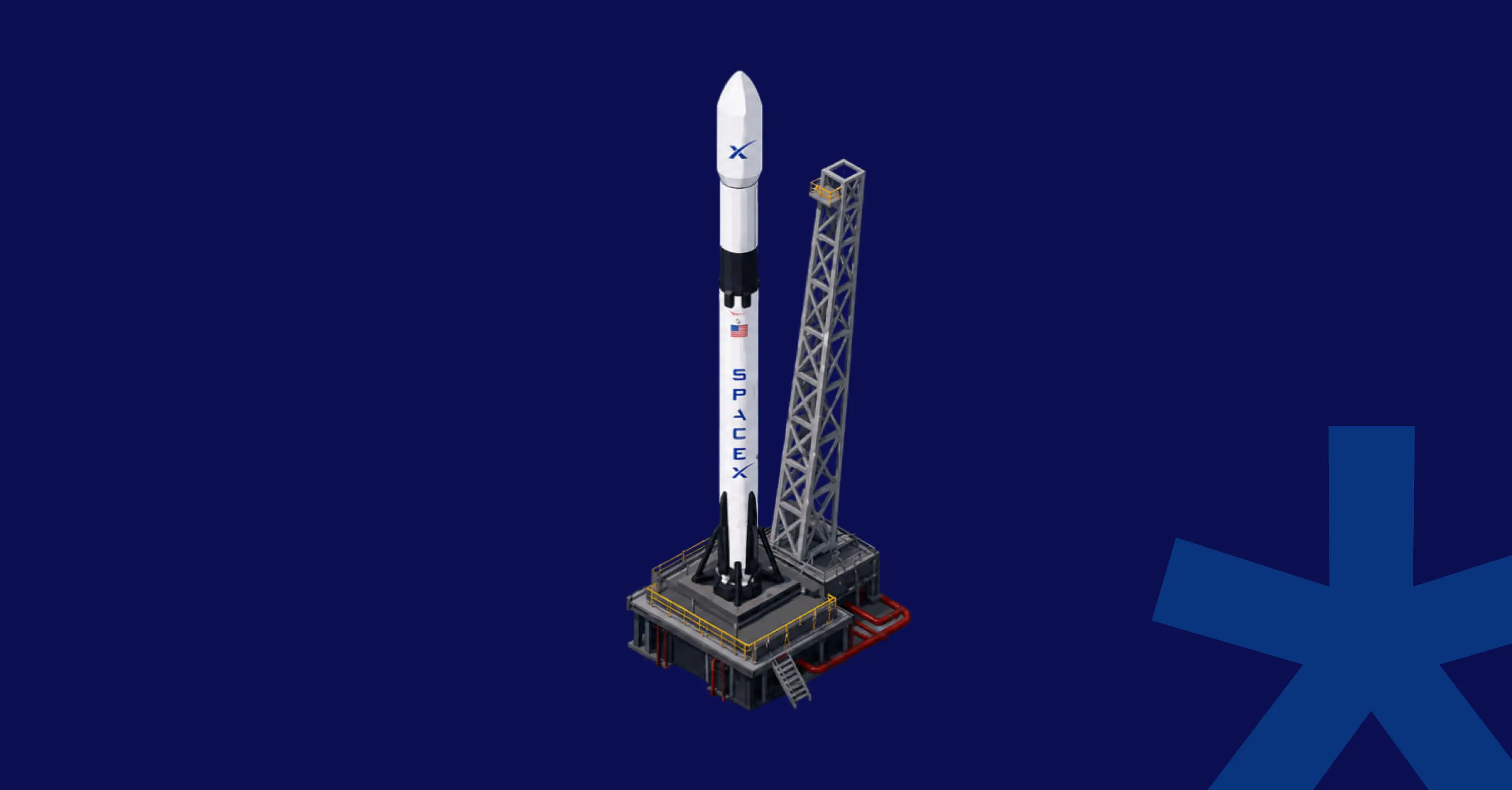
It’s September 2016. A SpaceX Falcon 9 is fueling on the pad at Cape Canaveral. Bolted to the top is a satellite called AMOS-6. Worth $200 million. Facebook had leased most of its capacity to beam internet across sub-Saharan Africa.
No countdown. No crowd. Just a fueling operation nobody was watching closely. Then, a fireball. The rocket explodes on the pad. The satellite is gone. The launchpad is destroyed.
Zuckerberg is in Africa at the time. He posts that he’s deeply disappointed. And the press runs with it as a shot at Elon Musk, two billionaires and a very expensive pile of ash.
Everybody covered the explosion. Every reporter wrote about whose fault it was. People wondered if SpaceX was cutting corners. And, of course, what it meant for the billionaire rivalry.
Here’s the question nobody was asking: Who pays for a $200 million satellite that just turned into a pile of dust?
Listen to the podcast or read the quick recap below.
The $200 Million Question
I went looking for who actually pays. And I figured the answer would lead somewhere sophisticated, that space insurance was just a bigger, fancier version of traditional insurance. Actuarial tables. Risk models. Teams of analysts running simulations.
It turns out the thing that makes normal insurance work, mountains of data, barely exists here. There are only a few dozen insured launches in a year. That’s nowhere near enough to build the kind of model your car insurance runs on. Every satellite is basically a one-off.
So instead of a formula, it runs on judgment and a very small room of people. There are only around 25 insurers in the entire world. One industry veteran I spoke with still tracks the whole market on a spreadsheet he started by hand in 1991. The entire loss history in space insurance is one single tab in one single spreadsheet.
That’s the real machinery of space insurance. Not a supercomputer. One guy’s spreadsheet.
And the market it describes is tiny. The whole world spends somewhere between $500 million and $600 million a year insuring everything in space. Every satellite, every rocket, all of it. U.S. drivers spend more than that on car insurance every single day.
Here’s how a satellite like AMOS-6 actually gets covered. A broker takes the risk to Lloyd’s of London and shops it around. It’s the same market that’s insured ships since the 1600s.
Inside Lloyd’s, no single insurer covers the whole loss. One takes 10%. Another takes 8%. It gets split up piece by piece, signature by signature, until enough insurers have signed on to cover the full $200 million.
There’s no formula. Nobody in that room has a model that spits out a number. It’s a handful of people making a judgment call on $200 million of the most advanced machinery that has ever been created.
Maybe space insurance isn’t exactly a science, but it’s a niche industry. And as long as the losses come one at a time, it works. And that’s exactly how it worked. Rockets went up. Fees were paid. Rates sat at record lows.
Then came 2023.
The losses that year ran past $1 billion, against a little over half a billion in premiums. The market paid out about double what it took in. Rates doubled almost overnight, and insurers walked away. Brit, which had led a Lloyd’s space consortium for more than 25 years, left the market entirely.
So after a year like that, you’d think everyone still flying would rush out and buy more coverage. But the opposite happened.
Going Naked
Most of space isn’t actually insured at all. The biggest reason is the company launching more than everyone else combined: Starlink. Thousands of satellites, almost none of them insured. And not because SpaceX can’t afford it.
The constellation is the insurance policy. A satellite dies, you don’t even bother filing a claim. You just launch another one. So the rocket company is off the hook. The operator carries everything. And more and more, the operator just decides to carry it with no insurance at all.
That leaves a big question. If the insurers aren’t covering all this, and the rocket companies owe nothing, then when something fails, who actually eats the loss? Some companies can absorb a failure. Some can’t. Same industry. One shrugs off a failure, one goes under. The difference is whether the risk was covered or just quietly carried.
There’s even a name for how casual the industry has gotten about carrying it with nothing: going naked. No policy at all, on a $300 million machine you can never touch again.
In June 2026, SpaceX went public in the largest IPO in history. The IPO changed almost nothing about how SpaceX runs. But it did change something else. When a company that size joins a major stock index, every fund built to track that index has to buy it. Not because a manager picked it. Because the rules say so.
SpaceX is now part of the Nasdaq-100, the index behind a long list of ordinary 401(k) and retirement funds. More than $800 billion tracks that index, and it now has to make room for a rocket company that insures almost nothing it puts in orbit.
The risk from all those uninsured rockets and satellites didn’t disappear when the biggest players stopped buying policies. Risk never disappears. It just moves to someone else.
For years it sat with a handful of private investors who chose it, eyes open. Now a sliver of it sits with millions of people who never chose it and never think about it. In a retirement fund with the word “space” nowhere in the name. Riding on every countdown. Priced by no one.
There’s always a policy. And when there isn’t, there’s still someone holding the risk. They just might not know it’s them.
Everything is insurance. Even the things that aren’t. Watch the full episode.
About Liberate
Liberate builds insurance-native Al agents that handle claims, servicing, and sales, trusted by carriers representing $100B+ in premiums on network.