AI's greatest opportunity in insurance goes beyond automating routine tasks. By giving adjusters, CSRs and producers more time for work that requires human judgment and expertise, insurers and agencies can improve service, strengthen relationships and create new opportunities for growth.
Insurance is about to get something it's never had: its most experienced people at full capacity, spending their days only on the work that actually requires them.
Most of the AI conversation in our industry still runs on subtraction. Which calls go away? Which routines get eliminated? What will the headcount look like next year? But subtraction is the smallest part of the AI story. The question that really matters is what adjusters do with the hours that they get back from automation.
Picture a Tuesday morning five years from now.
A policyholder calls at 6:40 a.m. to ask what she owes. She gets an answer on the first ring, makes the payment, and has a confirmation text before she backs out of the driveway. A contractor needs a certificate of insurance for a job starting at eight. He's got it in four minutes. A mortgagee change. An ID card. A lienholder update. A claim status check. An endorsement. A first notice of loss on a fender bender in a parking garage. All of it answered on the spot, resolved inside Guidewire or Applied Epic, written back, logged, and auditable.
Nobody on your team touched any of it.
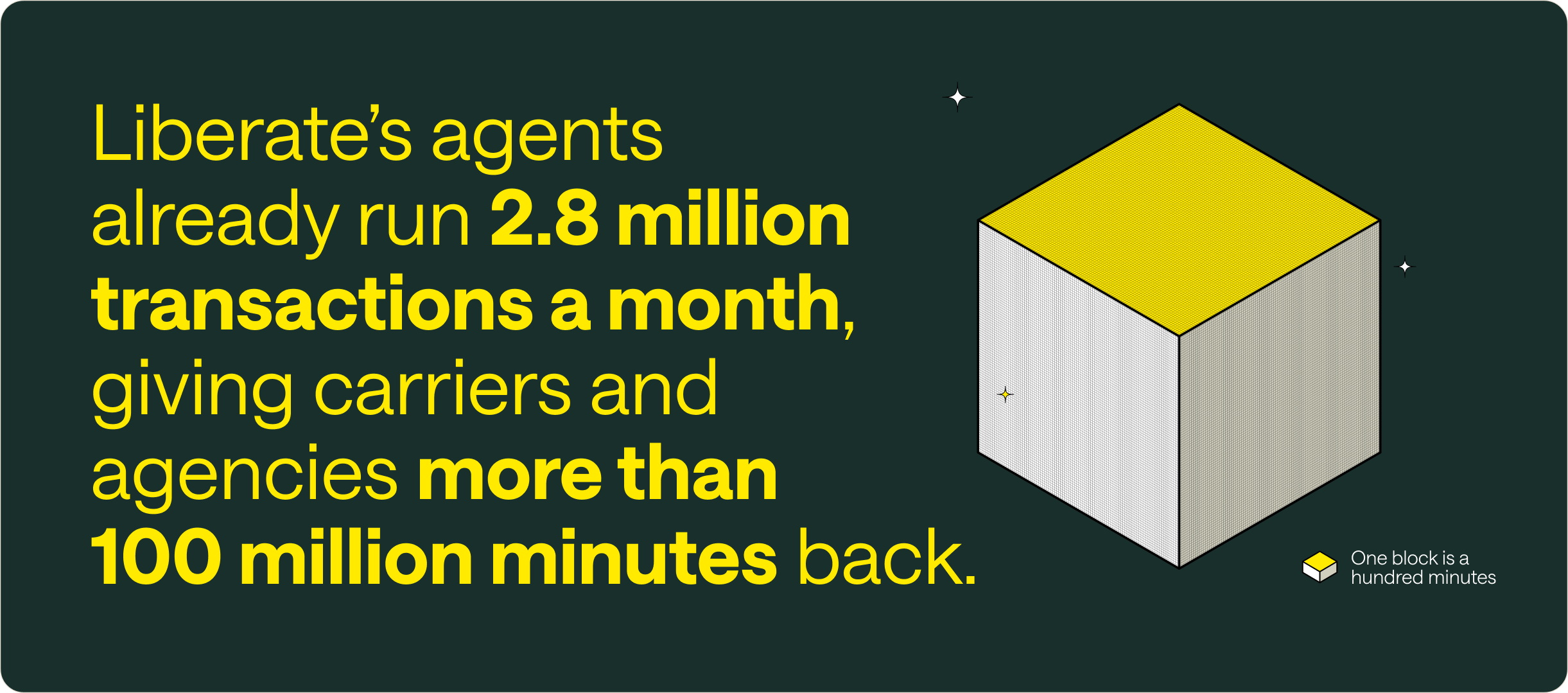
This is less speculative than it sounds. Liberate's agents already run 2.8 million transactions a month, giving carriers and agencies more than 100 million minutes back. A significant share of insurance work is fully capable of being handled by AI. The real question is what will you do with the time your team gets back?
So what do you do with the hours?
One obvious answer is reducing headcount. AI absorbs the volume, the team shrinks, the savings land next year. That's a real option, and for some organizations, it’s the right one. But reducing headcount isn’t the only way to capture the value of those hours..
Here’s where that answer falls short. The work that stays after AI handles the easy stuff is actually the most complex. It's the disputed claim, the underinsured homeowner after a total loss or the commercial account with a coverage gap nobody caught at renewal. That work doesn't get easier when AI takes the easy calls. It gets more concentrated. A team built around processing a high volume of simple requests doesn't automatically become a team that's equipped for the more complex work that’s left. .
The capacity AI creates can become savings, but it can also become something more valuable. The question is where you choose to put it.
Five places that capacity is worth more
More claims adjusting. Less admin.. Adjusters spend a startling share of the day on routine administrative work, from providing claim status updates to re-keying details into the claim file. Give some of that time back and it can be spent on coverage analysis, reserve accuracy, and documentation that holds up when a file becomes a lawsuit. Settlement accuracy moves loss costs. Providing status updates never did.
Outbound. An operation that isn't spending its day answering the phone can start using it. Call the policyholder before the payment lapses. Call before renewal, ahead of the non-renewal notice. Call the whole CAT-affected book on day two instead of waiting for them to find you on day nine. Every operation has a list of conversations worth having without enough hours to have them.
Producers producing, CSRs advising. On the agency side the math is blunt. When a licensed CSR spends an afternoon sending ID cards, you're using licensed talent for work that doesn't require it. Put that license back on coverage conversations, account rounding, and retention calls. Speed-to-answer drops to one second against a 74-second contact center average, and every lead gets a touch, including the ones the team used to reach after five.
Exception design, a job that barely exists yet. Exception management becomes a discipline of its own. Someone has to decide which requests the AI owns, where human judgement takes over, what happens at the edge, and how quickly the boundary should move. Somebody has to read the escalation log every week and ask why a warm transfer happened. Most organizations haven't named this role, staffed it, or written the job description. Do that now and you'll expand autonomy safely.
The apprenticeship, rebuilt on purpose. Routine work has been the training ground. It's where a new adjuster learns what a bad-faith setup sounds like, and where a new CSR learns the difference between what a customer asks for and what they really need. Remove that bottom rung without replacing it, and the pipeline to senior judgment can weaken over time. . Protecting busywork won't fix that. Building the replacement will: put juniors on the exception tasks, teach from escalation review, let them start where the judgment lives instead of spending three years earning the right to get there.
What it takes to make this model work
None of this arrives on its own, and anyone promising that it does is selling you a future disappointment.
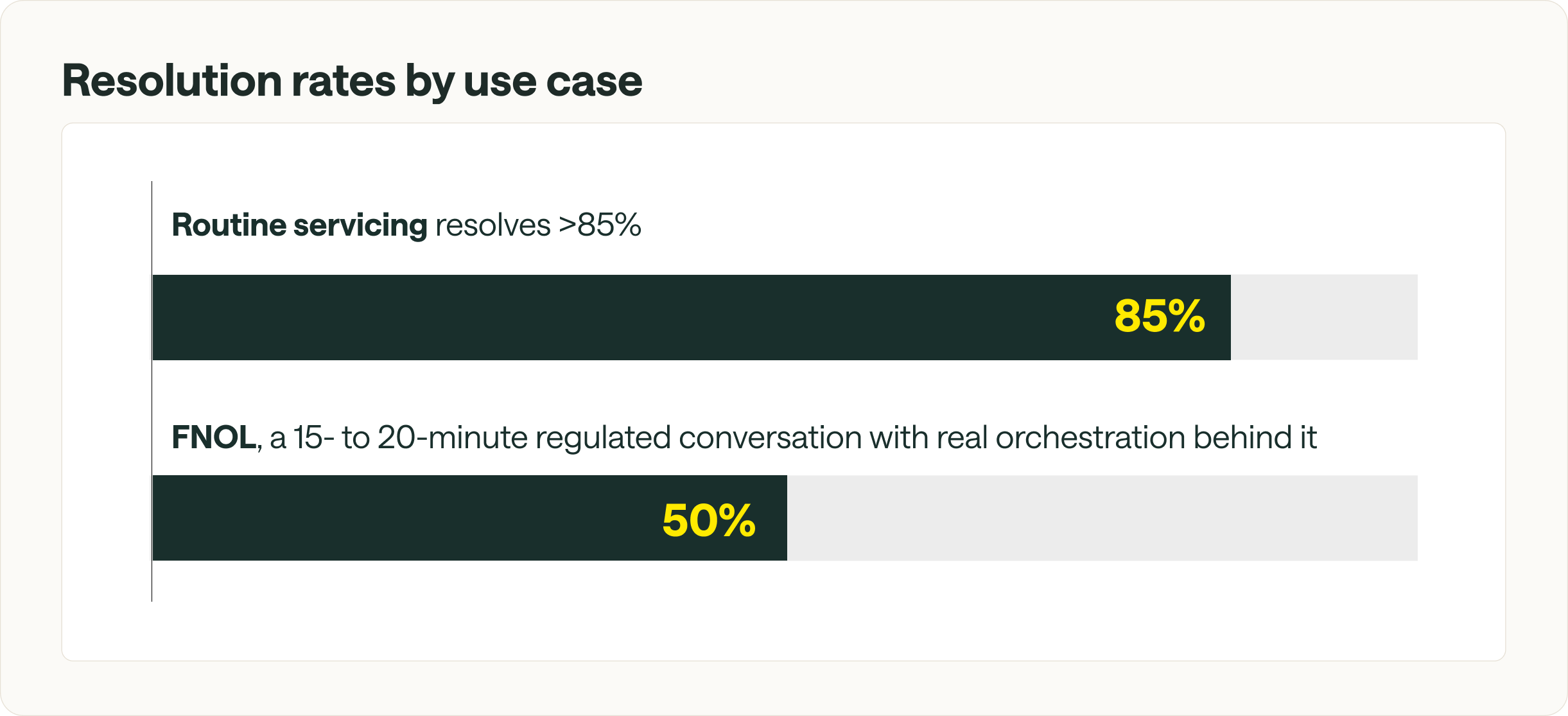
Resolution rates vary by use case, and a single blended number hides something. Routine servicing resolves 85% or more. FNOL, a 15- to 20-minute regulated conversation with real orchestration behind it, lands closer to half. Those are the ranges. Build the staffing model against those, not against an average.
Governance is what lets you expand. Every interaction needs real-time risk monitoring, an escalation path that carries full context on transfer, authority limits, and an audit record a regulator can read. That's the role of the Supervisor Layer: giving teams the controls and visibility they need to expand automation responsibly.
The reallocation itself is change management. Run it as a technology project and the capacity still shows up, just unclaimed. If you haven't decided where it goes, it gets spent on whatever's loudest that week.
What we're building toward
Go back to that Tuesday morning. Nothing about it looks like a breakthrough. A woman pays her bill from the driveway. A contractor gets his certificate and starts his job on time.
The part worth caring about is happening somewhere else in the building. An adjuster is on the phone with a family whose house burned down on Sunday, and she has the whole morning for them, because AI answered the 40 claim status calls that used to take up her entire morning. A CSR is walking a small business owner through a coverage gap that would have bankrupted him in a bad year. A producer is having the renewal conversation that used to fall behind more urgent requests..
That's the trade. The opportunity to move commodity work away from experienced people and give them more time for the work that depends on human judgment, empathy and expertise.
For as long as anyone has worked in insurance, the ceiling on how good an operation could be was set by the size of its workload. You could hire against it, outsource it, route around it. The incoming volume always sets the terms. AI changes that constraint. Human judgement becomes more valuable.
Decide where the hours go before they arrive. Our team can help you analyze your workload, understand resolution ranges by use case, and what the capacity plan looks like on the other side.
Key takeways
AI creates capacity, not just cost savings. Automating routine transactions gives insurers and agencies an opportunity to redeploy experienced employees to higher-value work.
Claims adjusters can focus on complex cases. With fewer administrative demands, adjusters can devote more attention to coverage analysis, settlement accuracy and policyholders who need personalized support.
Proactive outreach becomes more achievable. Freed-up capacity allows teams to focus on renewal conversations, payment reminders, catastrophe response and customer retention.
Human oversight becomes increasingly important. Effective automation requires clear escalation protocols, ongoing monitoring and defined boundaries between AI and human decision-making.
Workforce development must evolve. As AI takes over routine tasks, insurers need new ways to train employees, develop judgment and prepare the next generation of insurance professionals.
By clicking “Accept”, you agree to the storing of cookies on your device to enhance site navigation, analyze site usage, and assist in our marketing efforts. View our Privacy Policy for more information.